Wednesday, February 17, 2010

Why Do Our Feet Have Arches?

The arch on the right is in Bagdad. It was built in 2000 B.C. (4,010 years ago!) and is the oldest known arch in existence. However, the ancient Romans were the first to use arches in a variety of structures like aqueducts and buildings.

Architects know "that by using the arch configuration, significant spans can be achieved. This is because compressive forces hold it all together in a state of equilibrium". (Wikepedia/Arch)
Arches like the one in Bagdad or the Roman aqueducts have stood for centuries due to the incredible strength characteristics that arches provide regardless of the material used. The strength of the material is tripled when formed into the shape of an arch.
The body has many arches for the same reasons (strength and durability): The spinal column is made up of arches. the skull is curved in an arch and of course the foot has several arches.

In architecture and in the body if the shape of the arch is compromised the arch strength is compromised. If this happens in the body, the body will bend and shift in unnatural and painful ways.
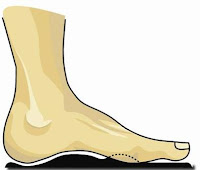
Unlike many over the counter orthotic insoles, Pedag has many orthotics that have a semi-rigid longitudinal arch support and have a metatarsal arch pad because Pedag wants to add to the strength of your natural arches. A cushioning insole might feel nice but it does not provide the foot with the extra strength it needs to fight the affects of gravity, weight and the erosions of time.
For orthotics that provide your feet with the strength they need to support your body in the correct alignment (of feet, ankles, knees, hips, back and neck) look to these Pedag insoles:


Holiday, Master, Pro-Active XCO, Solar Plus, Vitality, Viva

Friday, February 5, 2010

Sweaty Feet


Unless you are an athlete who has run a great race or a Swede in a sauna, being sweaty is not something most people enjoy. Being seen sweating (when you are not Swedish) provides clues to others that you are not the cool, confident character you want them to see since sweating is associated with being nervous, frightened or guilty of something.
But the physiological fact is that people sweat for a good reason. Sweating and shivering (thermo regulators) are the two main ways our bodies regulate our temperatures. If you are running a race (either for a prize or to catch your next meal) you sweat so your body keeps cool enough so you can continue to run without overheating.
Some parts of the body sweat more than others. Palms of the hands and soles of the feet have the largest number of sweat glands in the body. In fact, normal feet produce a shot glass full of sweat (about 1/2 cup) per day. Some people suffer from an inherited (genetic) condition known as Hyperhidrosis or sweating far in excess of the body's temperature regulatation needs. Plantar Hydrohidrosis is the term for feet that sewat excessively.
Whether you sweat normally or abnormally the confines of the shoe are ideal condions for problems to occur as a result of trapped moisture, warmth and humidity. These conditons inside the shoe create the perfect breeding ground for bacteria and fungus to grow. Bacteria and fungus cause odor in the shoe, destroy the interior of the shoe and can also promote and aggravate foot conditions like athletes foot.
In an effort to improve the environment inside many hiking boots and expensive dress boots, manufacturer’s use expensive, high tech linings made of air permeable membranes which allows air to circulate but prevents water from the outside from penetrating. This is the same material used to waterproof jackets so that they repel water but at the same time keep air circulating and your body heat from building up. Hikers know that the clothing worn under the jacket is equally important since clothes and jacket must work together to keep air circulating and wick away moisture from the body.
The same thing is equally true of your shoes and boots. The socks you choose and the insoles, orthotics and inserts you select, will enhance or ruin the cooling, moisture wicking effect of wearing shoes with leather linings, or canvas or cotton textile or a high tech membranes.
To prevent moisture from staying trapped inside your shoes, Pedag uses natural materials like vegetable tanned leather, cotton, wool, sisal and jute which allow the foot and shoe to "breathe". Pedag insoles will absorb the moisture from your sweat glands and keep that moisture away from your feet. All you need to do at the end of the day is allow the insoles to air dry and they are ready to go again.
In addition to the use of natural materials on the surface of Pedag insoles, Pedag also uses natural materials to add extra odor prevention. Natural active carbon filters used in many of our insoles to prevent odor build up (Viva, Master, Leather, Stop Odeur and Siesta). Recently, Pedag incorporated silver, which is a natural antibacterial agent, into several insoles. “Nano particle" sized silver ions are woven into the cotton of the Vitality and Deo-Fresh insoles providing permanent antibacterial properties. These two items are so comfortable and hygienic that they are ideal for when you do not want to wear any socks at all! Finally, some Pedag insoles and orthotics are even hand washable: Deo-Fresh, Vitality, Pro-Active XCO, Soft, Ultra Heel, Summer and Arctic Blue. To further enhance air circulation Pedag perforates some insoles: Soft, Aloe Vera, Alaska and Summer.
So you see, with every item Pedag makes, we think about your foot’s structure but also your over all comfort and well being.

Tuesday, January 12, 2010

Pedag Solar: Tested in extreme conditions!


This product review is as good as it gets. The customer who bought Pedag Solar posted this review on Amazon.com.


“I purchased these insoles to go in my fire "bunker" boots. I work at McMurdo Station, Antarctica, and our airfields are on snow and ice surfaces. The steel shanks and toes in our protective boots suck the heat right out of your feet - so much so that most of my colleagues use "toe warmers" in their boots every shift! These insoles are spectacular - they're thin enough that they don't really change the fit of my boots, the insulation is comfortable without being TOO spongy like some insoles, and the aluminized layer keeps the cold out below and the heat inside my boots. I would recommend these without hesitation to anyone who has to stand around on cold surfaces for any length of time, especially in footwear that isn't designed for cold weather. I've already given a pair to a colleague, and he's as excited about them as I am.”

Thanks very much!


By the way, it you need orthotic support in addition to the warmth of Solar try Solar Plus which is identical but also has full longitudinal and metatarsal arch support and a heel cushion.

Tip: How to find the correct location for Pedag inserts inside the shoe


This tip came from one of our customers and it is so easy and useful I thought we would "adopt" it (steal it) for our own.

Pedag makes small inserts, as opposed to full length or ¾ length insoles, which fit into shoes to support just the metatarsal arch or just the longitudinal arch. Once the insert is stuck to the shoe it can be difficult to remove. This tip will help you locate the correct spot in the shoe before you remove the adhesive "dot" so you will not need to move the insert again.

This customer who gave us this tip purchased Pedag T-Form metatarsal pad but the advice will work for any of our inserts such as: Drop, Step or Balance.

“I purchased these to help with the neuroma in my foot. It (T-Form) really helps ease the symptoms. The thing is that the adhesive is extremely good. That can be a problem if you stick it in the wrong place. Once it's stuck, it's stuck. That's great once you're walking, but it complicates things if you don't get it into the correct position on the first try. You might try using double sticky tape on it before exposing its adhesive, to test positioning in your shoe. Once you like its position, mark around it and then expose the adhesive applying it carefully where marked. Once stuck, it is nearly impossible to remove and tears up if you try.”

The thing that makes this such a good tip is that the location of inserts really should depend on user comfort based on user trial and error to find the perfect spot. There are formulas can instruct how to place the insert based on a line drawn across the widest part of the foot bisecting a line drawn from the heel to the second toe but this method does not address your unique, individual foot.
The “Velcro” method allows you to wear the insert for a few hours or days to be sure it is supporting the right spot for you.

Tuesday, December 22, 2009

Barefoot Running-Good or Bad?


The running shoe industry revenues total $2.3 billion annually. Barefoot running "shoes" sales topped $10 million this year. This new type of running shoe is probably sold in a store near you. What is the latest scientific thinking regarding the claims for and against running barefoot or with minimalist running shoes? The theory that supports barefoot running is expressed by Daniel Lieberman, a professor of human evolutionary biology at Harvard University, “People have been running for at least 2 million years and walking around for millions [of years] before that, and nobody ever wore shoes until fairly recently," In addition he says, "I do take an evolutionary approach to running, and I do believe one can run safely and healthfully barefoot." He has even begun to run barefoot himself. According to Christopher McDougall author of “Born to Run”, the problem with the modern running shoe is that the raised rear section of the shoe, which offers so much comfort, fundamentally alters your stride, encouraging you to land on your heel. But the heel that nature gave you was never intended to handle the impact forces of running. Each running stride brings forces equal to as much as three times your body weight down on your foot, which was designed to absorb that impact on the mid-sole and forefoot. Because they offer so much protection, and because many models control the way your foot lands, the shoes have made the muscles, ligaments and tendons in your foot and lower leg weaker, the argument goes. Over time, this can lead to injuries. The shoes also bunch toes that were meant to splay outward for balance. Many runners and some scientists, like Irene Davis, a professor in the department of physical therapy at the University of Delaware, agree.
According to a 2009 review article for the British Journal of Sports Medicine researchers could find no studies over the past 30 years that demonstrated that running shoes made people less prone to injury.
Barefoot running coach Ted McDonald believes that the easiest way to start barefoot running is to gradually incorporate it into your running workouts so that your ankles, etc. have time to get stronger. “Be light, be quick and be upright: Land gently and then instantly lift that foot back so you feel like you are in the air more than you are on the ground. At the same time keep your back straight and your feet right under your hips" he advises.

The case against barefoot running is summed up by Howard Ostermann, president of the District of Columbia Podiatric Medical Association who believes efforts to strengthen feet and ankles by gradually withdrawing the support that running shoes offer make sense. But (my emphasis) in the real world, he believes, "we lack the intrinsic musculature to run barefoot, or run in these minimalist shoes, without risking injury."
In addition, without running shoes, people would be susceptible to injuries from glass, rocks and other objects. And many exercise regimens would be ended, he says. The APMA Position Statement on Barefoot Running is: Barefoot running has become an increasing trend, and a possible alternative or training adjunct to running with shoes. While anecdotal evidence and testimonials proliferate on the Internet and in the media about the possible health benefits of barefoot running, research has not yet adequately shed light on the immediate and long term effects of this practice. Barefoot running has been touted as improving strength and balance, while promoting a more natural running style. However, risks of barefoot running include a lack of protection--which may lead to injuries such as puncture wounds--and increased stress on the lower extremities. Currently, inconclusive scientific research has been conducted regarding the benefits and/or risks of barefoot running. The American Podiatric Medical Association, along with the American Academy of Podiatric Sports Medicine, encourages the public to consult a podiatrist with a strong background in sports medicine to make an informed decision on all aspects of their running and training programs.


So what do I think? The potential for injury when running barefoot is real. The human body comes in a great variety of shapes and sizes. Not every body type is designed for running long distances, let alone running barefoot for long distances. Our ancestors did not live as long as we do and we do not really know whether they had painful feet or not! So my cautious approach says to wait until more evidence is gathered that indicates who candidates to regularly run barefoot are and who should stick to supportive, cushioned running shoes.

There is a way to try a minimalist running shoe without taking too big a risk. For those who want to take a cautious approach to their foot health but still want to try running in minimalist running shoes, Pedag USA recommends using our semi-rigid sports orthotics such as: Vitality, Pro-Active XCO and Master. These insoles are very thin with little added cushioning so they will fit into minimalist running shoes (after all it is the cushioning in normal running shoes that is believed to alter the runners stride and cause injuries). These insoles all have a heel cushion, metatarsal pad and semi-rigid longitudinal arch support. Why not support your arches even if you decide to run without the bulk and restrictions of a stiff cushioned running shoe?


Sources and Links:

http://www.apma.org/
http://www.washingtonpost.com/wp-dyn/content/article/2009/10/12/AR2009101201591.html

http://www.aapsm.org/

http://www.parade.com/health/2010/01/03-barefoot-running.html


Monday, December 21, 2009

Update to Post dated 11/23/2009: New Items are Selling Well & A Fun Consumer Review


It is always exciting to introduce a new item. Last month we introduced 5!
We created 4 Kits with a different selection of Pedag insoles in each and we added Pedag Angora to our product line.

We can now announce that the new items are selling really well. It seems customers like help with selecting insoles for various activites and they do not mind getting a discount when they buy the insoles in a Kit.
Angora is a nice year round item. Angora hairs keep the rabbit (and the human) cool in summer and warm in winter. The insole is ultra thin and perfect for even the dressiest shoes and boots.

We got a really cool review from a consumer who bought Pedag Solar Article 145 .
Scott Mosher posted this on Amazon December 2nd, 2009:

"I purchased these insoles to go in my fire "bunker" boots. I work at McMurdo Station, Antarctica, and our airfields are on snow and ice surfaces. The steel shanks and toes in our protective boots suck the heat right ouf of your feet - so much so that most of my colleagues use "toe warmers" in their boots every shift!

These insoles are spectacular - they're thin enought that they don't really change the fit of my boots, the insulation is comforable without being TOO spongy like some insoles, and the aluminized layer keeps the cold out below and the heat inside my boots.

I would recommend these without hesitation to anyone who has to stand around on cold surfaces for any length of time, especially in footwear that isn't designed for cold weather. I've already given a pair to a colleague, and he's as excited about them as I am."

Thanks Scott!

Friday, December 18, 2009

One year anniversay of the start of my Plantar Fasciitis saga

For the first part of the story see the Post dated 11/19/2009.
Also, for information on Plantar Fasciitis use the following link to the
Foot Conditions page on the Pedag USA website.

I went on a 9 day trip to visit relatives on the east coast earlier this month. Before I left, my plantar fasciitis related heel pain was bad enough that I could not walk even a few blocks without pain. So I went to my podiatrist again just before I left for another silicone injection so that I could get around while I was away. My podiatrist said I was an obstinate case. It seems some people get better after a round of silicone injections, OTC orthotics and massage. Not me. In my case, I can expect everything to take longer.
So after my shot I went on my trip. Unfortunately, the pain did not appreciably improve. My trip was a happy one but not because I could walk around comfortably.
When I got back I planned to see my podiatrist again. However, I am putting it off because every once in a while I realize that the pain is virtually gone! Then the pain comes back, in a different spot on my heel and then it goes away again!
I think I will wait and see what is going on before I make an appointment.
I'll let you know if anything changes or if a new therapy is successful.

Happy New Year!
Rose